Prensa
For commercial vehicle fleets, operating conditions vary significantly across different axles, resulting in noticeable differences in tire wear rates and wear patterns.
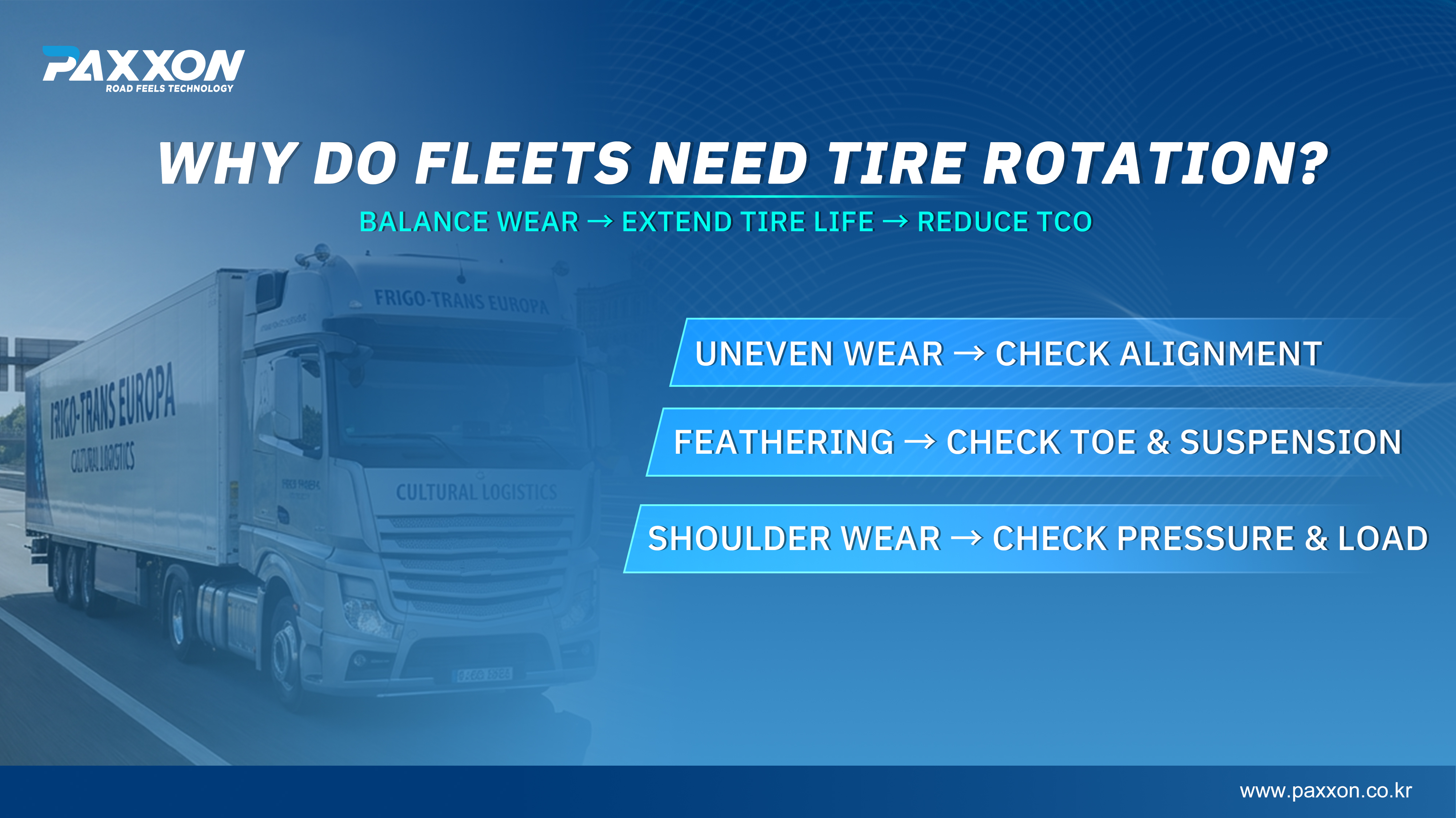
Therefore, proper and systematic tire rotation is an important part of professional fleet tire management. Its value goes beyond balancing tread wear and making full use of the remaining tread. More importantly, it helps ensure that tires from the same batch reach similar service lives, enabling synchronized retirement, retreading, and batch replacement. This can reduce the additional costs caused by unplanned tire replacement, premature retirement, and mixing new and old tires, ultimately helping fleets lower their overall TCO.
Long-term lack of proper tire management can lead to various types of irregular wear, including one-sided wear, feathering or sawtooth wear, stepped or wave-like wear, and localized rapid wear.
Irregular wear is often related to vehicle mechanical conditions or operating conditions:
· One-sided wear → Check tire pressure, camber, axle alignment, and wheel alignment.
· Feathering/sawtooth wear → Check toe alignment, suspension components, and related mechanical parts.
· Excessive shoulder wear → Check tire pressure, vehicle load, and actual operating conditions.
However, it is important to emphasize that tire rotation is not a solution for correcting irregular wear, nor is it a universal fix. If the root cause is not identified before rotation, the existing irregular wear may be transferred to another axle, allowing the problem to spread.
Tire rotation must take into account axle position, tire size, tread pattern, and wear condition.
Directional tires must maintain the correct rolling direction. For dual tires, attention should be paid to tire size, overall diameter, tread depth, and tire pressure matching. Excessive differences can lead to uneven loading, overloading of individual tires, and abnormal heat buildup.
In particular, highly worn or unevenly worn tires from the drive axle should not be arbitrarily moved to the steering axle. The steering axle has higher requirements for tire roundness, uniformity, and overall condition. Tires with significant uneven or stepped wear may affect vehicle stability if they are fitted to the steering axle without professional assessment.
For professional fleets, tire management is far more than simply rotating tires. It should be a complete management process:
Tire pressure checks → Tread wear inspection → Irregular wear identification → Root-cause diagnosis → Vehicle adjustment → Proper tire rotation → Data tracking
Scientific tire rotation and systematic tire management can help fleets balance tread wear, extend overall service life, implement more efficient batch tire management, reduce frequent tire replacement and unplanned maintenance costs, and ultimately improve operational stability while optimizing overall TCO.
Tire rotation is not simply about changing tire positions. It is an important part of scientific fleet tire management.
PAXXON — Trusted by European Truck Fleets.