
Prensa
08 Oct 2026
CPK vs. Purchase Price: What Should Fleets Really Measure?
Does a lower purchase price really mean lower costs?
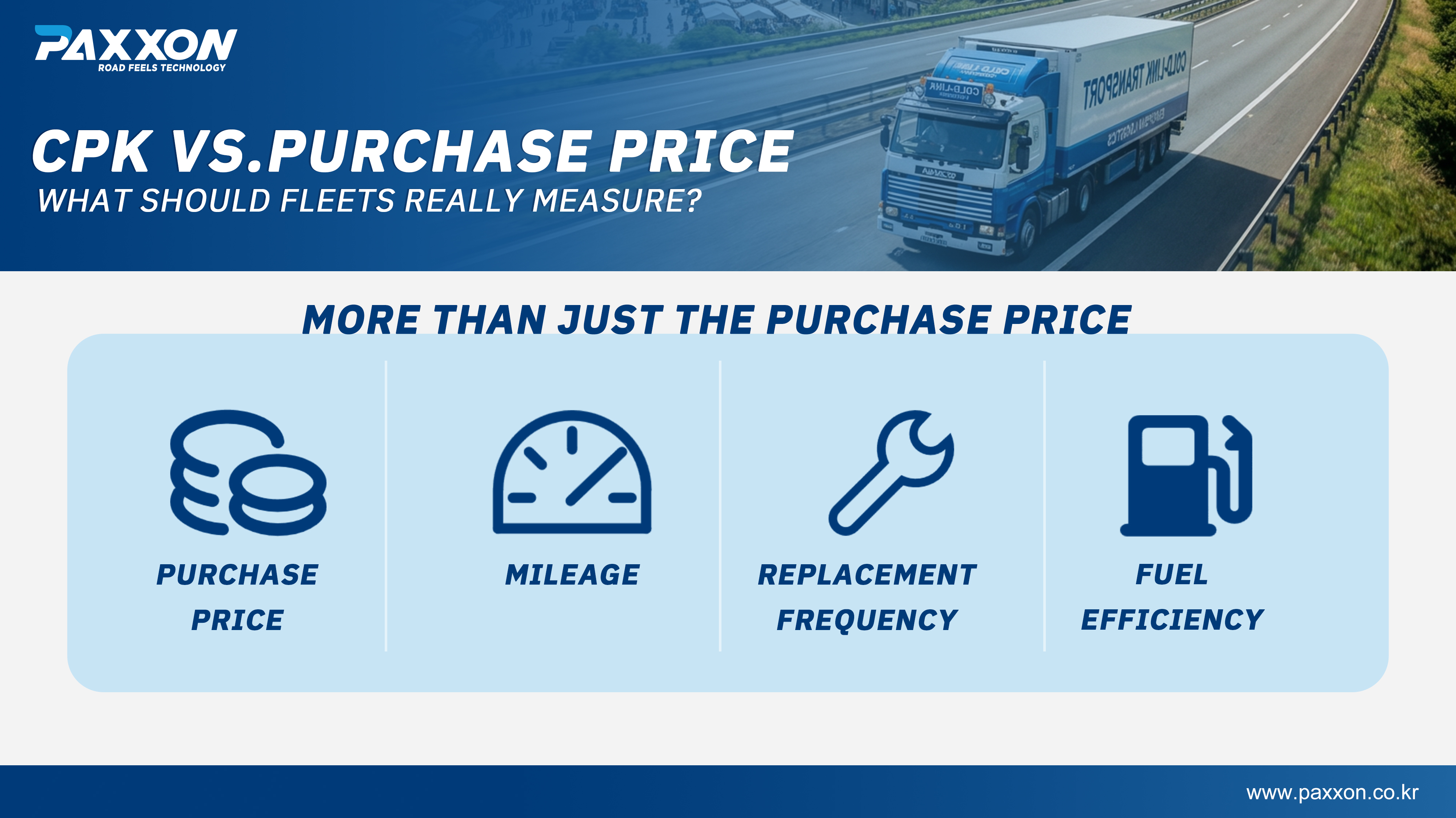
For commercial fleets, the purchase price is only the starting point of tire costs. Actual operating costs also depend on mileage, replacement frequency, and fuel efficiency.
From purchase price to CPK, a lower-priced tire does not necessarily mean a lower cost per kilometre.
CPK (Cost Per Kilometer) = tire Cost ÷ Actual Mileage
For example, if a €400 tire runs for 100,000 km, its CPK is €0.004/km. If a €450 tire can run for 150,000 km, its CPK is only €0.003/km. A higher purchase price does not necessarily mean higher operating costs. What matters is how many kilometres the tire can deliver.
Tire costs can also affect other operating costs. The European Commission points out that rolling resistance is closely linked to truck energy consumption; for diesel heavy-duty vehicles, it can account for around 30–40% of energy consumption.
Therefore, when evaluating tires, fleets need to look beyond the purchase price and consider CPK and TCO.
The purchase price is the starting point, CPK measures the cost per kilometre, while TCO provides a broader view of the true cost over the operating lifecycle.
PAXXON looks beyond how much a tire costs to purchase. We focus on how efficiently it can deliver mileage and value in real-world fleet operations.
From purchase price to CPK, and ultimately to lifecycle value—the true measure of a tire is its operating performance.
volver